

TL;DR — Quick Answer:
There is no single magic number — but most reconciliations happen between 30 days and 5 months. The timeline depends on the type of breakup, how well you use the no contact period, and critically — your ex’s personality type. The only part of this timeline you can actually control is how fast you grow.
You’re looking at the calendar, aren’t you?
Counting the days since the breakup. Maybe you’ve even circled a date a month from now, hoping it’s the day things will magically be okay again. You’re asking Google, “How long does it take to get your ex back?” because what you’re really asking is, “When will this pain stop?”
I get it. That need for a concrete timeline is a desperate search for hope in the middle of chaos.
“There were days I couldn’t get off the couch. Not wouldn’t — couldn’t. The weight of it was physical. I’d stare at the ceiling and think: this is it. This is what the rest of my life feels like. Everything I’d built, everything I’d believed in — gone. Depression doesn’t announce itself. It just quietly takes over, until one day you realise you haven’t laughed in weeks and you can’t remember the last time you felt like yourself.”
— Robert Martin Lees
Depression after a breakup isn’t weakness. It’s love with nowhere to go. And the desperate need for a timeline? That’s the same thing — love trying to find a container.
 Here’s the honest truth: there is no single magic number. But there are predictable patterns, psychological phases, and realistic timelines. The goal isn’t to passively wait for a date on the calendar, but to understand the journey your ex is on — and more importantly, the one you need to be on yourself.
The most critical part of this process is creating space, which starts with understanding if the No Contact rule really works.
In This Article
- The Core Reason for the Delay: Two Different Timelines
- The Variable Nobody Talks About: Personality Types
- Realistic Timelines for These Journeys to Intersect
- How to Influence the Timeline (The Only Part You Control)
- When You Need a Structured Strategy: The Ex Factor Guide
- Frequently Asked Questions
- Tired of Guessing? Get a Clearer Picture
The Core Reason for the Delay: Two Different Timelines
The biggest mistake people make is assuming their ex is on the same emotional journey they are. They’re not. For reconciliation to even be possible, your two separate timelines have to intersect.
The Dumper’s Timeline (Relief → Curiosity → Nostalgia)
The person who ended the relationship is on a completely different path.
- Phase 1: Relief (First 1–4 weeks): Immediately after the breakup, they don’t feel sadness — they feel relief. They’ve been wrestling with this decision for weeks, maybe months. The conflict is finally over. This is why chasing, begging, or pleading right now is the worst thing you can do. You are an irritation to their newfound peace.
- Phase 2: Curiosity (Weeks 4–8): After a period of disciplined silence from you, their relief starts to fade. A new feeling creeps in: curiosity. “Why haven’t they called? I thought they couldn’t live without me. Are they okay? Are they… dating someone?” This is the first crack in their certainty.
- Phase 3: Nostalgia & Regret (2–3+ Months): If you’ve stayed strong and focused on your own life, their curiosity can evolve into nostalgia. They start remembering the good times, not the bad. They see you looking genuinely happy — not fake happy — and a powerful thought enters their mind: “Did I make a mistake?” This is where true regret is born.
Your Timeline (Shock → Acceptance → Growth)
Your journey is the mirror opposite.
- Phase 1: Shock & Pain: This is where you are now. Chaotic, painful, desperate.
- Phase 2: Acceptance & Action: This is when you stop fighting the reality of the breakup and start channelling your energy into growth. Read our self-improvement after breakup guide for the exact steps.
- Phase 3: Genuine Growth: This is the magic phase. Your happiness is no longer tied to whether they come back. You are rebuilding your life, reconnecting with friends, finding joy on your own. Ironically, this genuine detachment is the most attractive thing you can possibly project.
Reconciliation only becomes possible when they enter their Nostalgia phase while you are in your Growth phase.

The Variable Nobody Talks About: Personality Types
Why Your Ex’s Personality Type Changes Everything
Here’s what almost nobody in this space will tell you: the standard timeline framework only works if you apply it correctly for your ex’s specific personality type.
A one-size-fits-all approach is why so many people fail. They follow the generic advice, do the no contact, wait the 30 days — and then reach out in completely the wrong way for who their ex actually is. And it blows up.
I’ve seen this pattern over and over. The strategy has to match the person.
The Avoidant Ex — The Longest Timeline
If your ex has an avoidant attachment style — they pull away when things get emotionally intense, they value independence fiercely, they rarely initiate emotional conversations — you are dealing with the longest and most delicate timeline.
- No contact is essential — but it must be genuine, not strategic. Avoidants have finely tuned radar for manipulation.
- Their “relief” phase is longer than average — often 6–10 weeks before curiosity kicks in.
- Reaching out too soon, or with too much emotional weight, will trigger their withdrawal reflex immediately.
- Timeline: 3–6+ months for genuine reconnection.
The Anxious Ex — The Fastest But Most Volatile Timeline
If your ex is anxiously attached — they overthink, they need reassurance, they spiral when they feel abandoned — the timeline can move faster, but it’s also the most unstable.
- They will likely reach out during no contact. This is a test, not an invitation.
- Their curiosity phase arrives quickly — often within 2–3 weeks — but it can flip back to anger just as fast.
- The key is calm, grounded responses. Not cold. Not desperate. Steady.
- Timeline: 30–60 days if handled correctly. Can extend to 3–4 months if mishandled.
The Secure Ex — The Most Straightforward Timeline
A securely attached ex is the most rational to work with. They process emotions clearly, they don’t play games, and if the relationship had genuine value, they’re open to honest conversation.
- No contact still applies — but the purpose here is your growth, not their psychology.
- They will respect space and won’t chase. But they also won’t wait forever.
- When you reach out, be direct, honest, and growth-focused. No games.
- Timeline: 30–90 days is typically sufficient.
The Fearful-Avoidant Ex — The Most Complex Timeline
This is the most challenging personality type to navigate. Fearful-avoidants want closeness but are terrified of it. They push you away and then panic when you actually leave. They send mixed signals constantly — not to manipulate you, but because they genuinely don’t know what they want.
- Standard no contact can trigger abandonment panic — which looks like hope but isn’t.
- Their hot-and-cold behaviour is not a green light. It’s a trauma response.
- This personality type almost always requires a structured, psychologically informed approach — not just patience.
- Timeline: 3–8 months, and only with the right strategy.
Understanding your ex’s attachment style isn’t just interesting psychology — it’s the difference between a strategy that works and one that pushes them further away. This is exactly where a structured program like the Ex Factor Guide becomes genuinely valuable — it’s built around these personality-specific dynamics in a way that generic advice simply isn’t.
Realistic Timelines for These Journeys to Intersect
Based on this psychological framework, here are the most common scenarios.
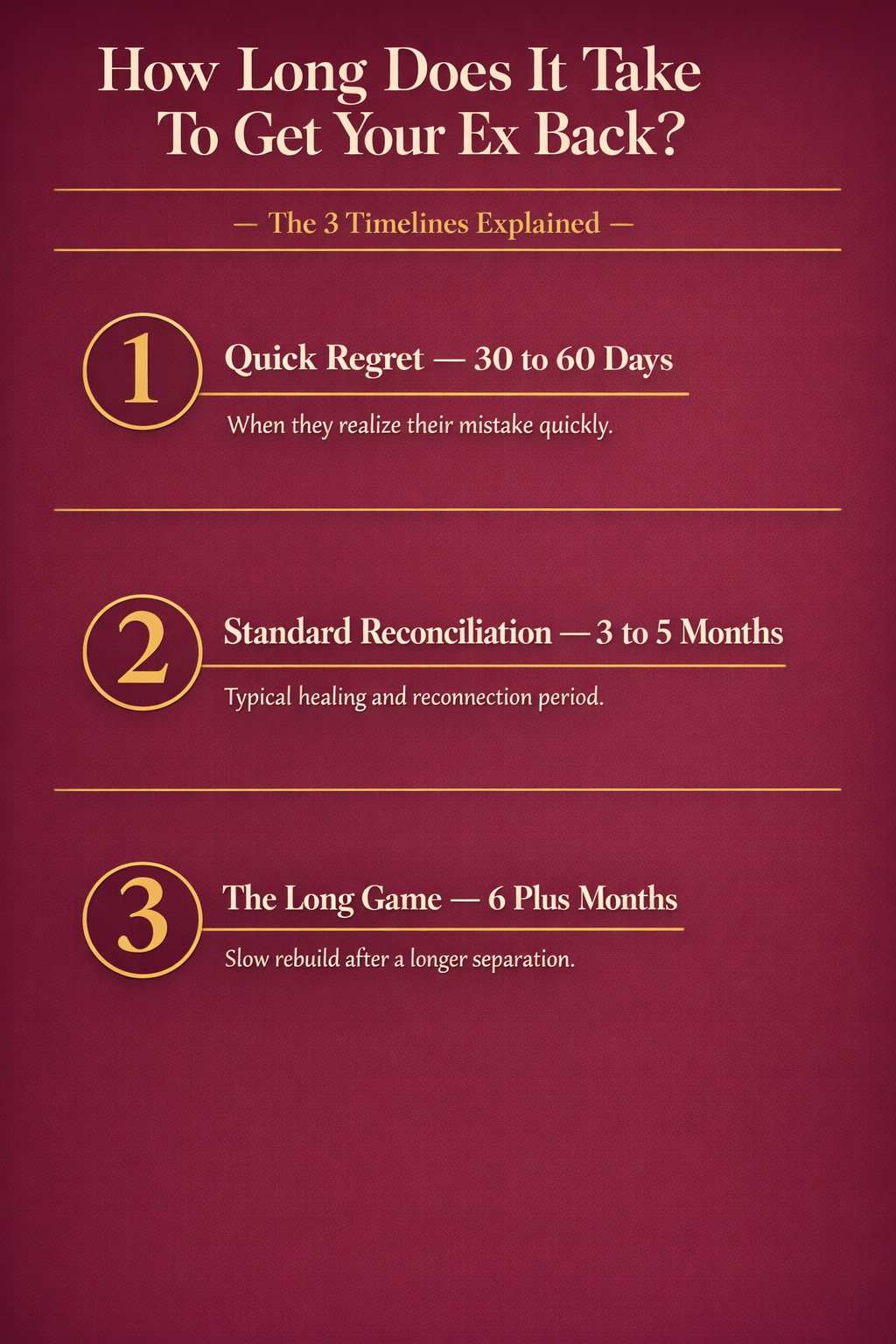
Scenario A: The “Quick Regret” (30–60 Days)
Rare, but real. Common in shorter relationships or amicable breakups where the dumper’s relief phase is very short. They quickly experience life without you, find it lacking, and their curiosity and nostalgia phases accelerate. Usually involves a securely attached or anxious ex.
Scenario B: The “Standard Reconciliation” (3–5 Months)
The most common and healthiest path. Allows for a full 30–60 day no contact period, giving them space to complete their emotional cycle. Also gives you enough time to achieve genuine, noticeable growth. Works across most attachment styles when the strategy is right.
Scenario C: The “Long Game” (6+ Months)
Necessary for breakups involving deep wounds — infidelity, long-term relationships, avoidant or fearful-avoidant exes, or situations where trust was severely broken. It takes significant time to rebuild trust and for both people to prove that the negative patterns of the past have truly changed.
It’s natural to worry if too much time has passed. We have a whole guide on when is it too late to get your ex back that can offer some peace of mind.
How to Influence the Timeline (The Only Part You Control)
You cannot speed up your ex’s emotional journey. Rushing them will only push them away.
The only thing you can control is accelerating your own journey. The faster you move from Shock to genuine Growth, the more likely you are to be in that attractive, confident headspace when their curiosity and nostalgia finally kick in.
“Recovery didn’t feel like a victory lap. It felt like one morning I woke up and the first thought wasn’t about her. It was just… a thought about the day. Small. Ordinary. And somehow, enormous. It crept in like that — slowly, in the margins. I started to feel like I was worth something again. Not because she came back. Not because anyone validated me. But because I’d done the work, faced the ugly parts, and was still standing. The hope I found wasn’t ‘I’ll get her back.’ It was ‘I’ll be okay either way.’ And that — that right there — is actually when the real chance of getting her back began.”
— Robert Martin Lees
The moment you stop needing them back is often the moment they start coming back.
When that moment comes, you’ll be ready to send the right kind of message. Knowing what to text after no contact is key to re-opening the door correctly.
When You Need a Structured Strategy: The Ex Factor Guide
Why Generic Advice Isn’t Enough for Complex Situations
Here’s something I’ve learned from walking through this with hundreds of people: the more complex your situation, the more dangerous generic advice becomes.
If your ex is avoidant, fearful-avoidant, or if the breakup involved serious trust damage — following standard “wait 30 days and text them” advice can actively set you back. You need a strategy that accounts for who your ex actually is, how they process emotions, and what specific triggers will either open the door or slam it shut.
This is where a structured program like the Ex Factor Guide can be genuinely beneficial. It’s not a magic trick. It’s not manipulation. It’s a psychologically grounded framework built specifically around the personality dynamics and emotional phases we’ve been discussing in this article.
I’m not going to tell you it works for everyone — nothing does. But if you’re dealing with a complex personality type, a long-term relationship, or a situation where you’ve already made some of the classic mistakes, having a structured roadmap is far better than guessing.
You can read my full honest breakdown in the Ex Factor Guide review — including what it does well and where its limits are.
Frequently Asked Questions
How long does it take to get an ex back?
Most reconciliations happen between 30 days and 5 months. The exact timeline depends on the type of breakup, your ex’s personality and attachment style, and how effectively you use the no contact period for genuine personal growth. There is no universal number — but there are predictable patterns.
How to get my ex back quickly?
The fastest path to reconciliation is counterintuitive: stop trying to get them back and start genuinely improving yourself. The “quick regret” scenario — 30 to 60 days — happens most often when the dumpee stops chasing, goes quiet, and visibly moves forward. That shift in energy is what triggers curiosity and nostalgia in the dumper.
How to get your ex back in 30 days?
A 30-day reconciliation is possible but rare — it typically requires a shorter relationship, an amicable breakup, and a securely or anxiously attached ex. The 30 days must be spent in genuine no contact, active self-improvement, and zero social media monitoring. If you reach out at day 30 from a place of desperation, it will not work. If you reach out from a place of genuine growth, it might.
How to get your ex back after a long time apart?
Getting your ex back after a long time apart is absolutely possible — and sometimes the extended separation is exactly what both people needed. The key is demonstrating genuine change, not just claiming it. Reach out with something real and low-pressure. Reference a shared memory or something you know they care about. Make it about connection, not reconciliation.
How long to heal before trying to get an ex back?
You are ready to reach out when you can honestly say you would be okay if they said no. Not performing okay — genuinely okay. That usually takes a minimum of 30 to 60 days of no contact combined with active self-improvement work. For longer relationships or deeper wounds, 90 days is more realistic.
How to rekindle love with an ex?
Rekindling love with an ex starts with rebuilding emotional safety — not romance. Before any grand gesture or heartfelt conversation, you need to re-establish a low-pressure connection. A casual, warm message. A shared laugh. A reminder of who you were together before things got complicated. Romance follows safety. Never the other way around.
Why does it take so long to get an ex back?
It takes time because the person who ended the relationship needs to complete their own emotional cycle — from relief to curiosity to nostalgia. This process cannot be rushed. Any attempt to accelerate it through contact, pressure, or emotional appeals will reset their clock back to the relief phase. Time, combined with your genuine growth, is the only thing that moves this forward.
Can I get my ex back after a long time apart?
Yes — and sometimes a longer separation produces a stronger reunion. Both people have had time to mature, to miss what was real, and to let the negative emotions fade. If you both have genuinely grown, a reunion can be more grounded and lasting than the original relationship. The question is not whether it’s possible — it’s whether you’ve both done the work.
What are the signs my ex wants me back?
The key is to observe their actions, not just their words. For a complete breakdown, read our detailed guide on the signs your ex still cares — covering everything from social media behaviour to the types of messages they send.
Tired of Guessing? Get a Clearer Picture.
These timelines are a guide, but your situation is unique. The length of your relationship, the reason for the breakup, your ex’s personality type, and your actions right now all play a role.
To get a personalised analysis of your specific situation, take the 60-second Breakup Clarity Quiz. It will help you understand your chances and give you the next steps you should take.
About Robert Martin Lees
 Robert Martin Lees is a relationship coach and author at Making Up Magic. He is not a therapist. He is a survivor — a man who inherited a broken cycle of love, ran it for decades, and found a way out through radical self-reflection and the slow, unglamorous work of becoming someone worth loving. His authority is earned through lived pain, not academic credentials. He writes from the inside of the experience — not the outside looking in. His work is also published at LessonsToLove.info and ChangingTheCycle.com.