

You’ve done the hard part. The silence. The discipline. The days when you nearly caved and typed something you’d regret.
And now you’re here — no contact period done, phone in hand, cursor blinking on a blank message screen.
I know that feeling. I’ve lived it.
There’s a sentence I’ll never forget. She looked at me and said, “You have no chance. There’s someone else.” Five words. And just like that, the floor disappeared. I’d been holding onto hope like it was the only thing keeping me upright — and in one sentence, she took it.
What I didn’t know then was that those words were actually the beginning of my recovery. Because you can’t rebuild on false hope. Sometimes you need the truth to hit you that hard before you’re finally willing to look at yourself honestly — and do the work that makes a real reconnection possible.
That work? It starts with this text.
Not a confession. Not a plea. Just a door, gently reopened.
Here are 15 first texts after no contact that actually work — plus the psychology, timing, and mistakes that will make or break your chances. If you want the broader strategy first, start with my guide on what to text your ex after no contact.
Why the First Text After No Contact Feels So High-Stakes
Silence is powerful. After weeks of no contact, both you and your ex have adjusted to the quiet. Your nervous system has recalibrated. So has theirs.
This makes the first message feel enormous — psychologically, this is called the spotlight effect. We assume what we say matters far more than it actually does to the other person. The truth? Most exes don’t read that first text as “life or death.” They feel something simpler: curiosity.
That’s your opening. Not drama. Not declarations. Just a small, warm spark of curiosity.
Overthinking is your biggest enemy right now. The longer you wait to send something simple, the more pressure you pile onto a message that should feel effortless.
When to Send Your First Text After No Contact
Timing matters more than most people realise. Send too early and the emotional wounds are still raw — yours and theirs. Wait too long and the momentum you built during no contact starts to fade.
The sweet spot: 21–45 days, depending on the length and intensity of the relationship.
- Short relationship (under 6 months): 21–30 days is usually enough.
- Long-term relationship (1+ years): 30–45 days gives both of you space to genuinely reset.
- High-conflict breakup: Lean toward the longer end. Let the emotional temperature drop fully.
One more thing: don’t text late at night. Mid-morning to early afternoon is ideal — they’re awake, not in bed, and not in a social situation where your message feels intrusive.
If you’re still unsure whether you’ve done enough no contact, read my full breakdown on does no contact work before you hit send.
What Your First Text Should (and Shouldn’t) Do

Think of your first text like a first knock on a door — not a dramatic re-entrance. Here’s the framework:
- ✅ Should: Spark curiosity with something small or shared.
- ✅ Should: Show you’re calm, grounded, and doing okay.
- ✅ Should: Leave natural room for them to reply.
- ✅ Should: Be under 2 sentences where possible.
- ❌ Should NOT: Be an emotional confession or apology.
- ❌ Should NOT: Demand answers, clarity, or a response.
- ❌ Should NOT: Sound like you’ve been rehearsing it for weeks (even if you have).
- ❌ Should NOT: Reference the breakup, the silence, or what went wrong.
Less is more. Every single time.
15 Best First Texts After No Contact
1. The Memory Trigger
“Hey, random memory popped up today — remember that tiny cafe with the cinnamon rolls? Still the best coffee I’ve ever had.”
Why it works: Shared, lighthearted, zero pressure. Reminds them of positive times without saying “I miss you.”
2. The Curiosity Ping
“Quick question — didn’t you once say your cousin moved to New York? Something today reminded me of it.”
Why it works: Opens the door with a neutral subject that’s still personal enough to invite a reply.
3. The Call-Back
“Okay, you win. That artist you swore I’d like — I finally listened. You were right.”
Why it works: Playful admission. Invites a smile without any emotional weight.
4. The Simple Check-In
“Hey, hope you’re doing well. Saw something today that reminded me of you.”
Why it works: Neutral, warm, not overbearing. The vagueness of “something” naturally invites curiosity.
5. The Humor Hook
“You’ll laugh at this — someone actually mispronounced [inside joke reference] today. Thought of you instantly.”
Why it works: Humor lowers emotional stakes and reminds them of your unique chemistry.
6. The Value Drop
“Hey, saw [band/show/restaurant] is back downtown. Figured you’d want to know.”
Why it works: Pure contribution, zero expectation. You’re giving, not asking.
7. The Genuine Compliment
“I was thinking about that thing you said about [topic] a while back. You were more right than I gave you credit for.”
Why it works: Validates them without flattery. Shows growth and self-awareness.
8. The Shared Interest Update
“Finally finished [book/show/game] you recommended. Had thoughts. Good call.”
Why it works: Signals you’ve been living your life — and that they still have a positive presence in it.
9. The Light Question
“Random — do you still have that recipe you made that one time? I’ve been thinking about it.”
Why it works: Practical, non-threatening, and gives them an easy reason to reply.
10. The Milestone Mention
“Just got back from [trip/event/achievement]. Reminded me of when we talked about doing something like that.”
Why it works: Shows forward momentum in your life while creating a warm shared reference point.
11. The Soft Re-Entry
“Hey. Hope things are good with you. Been a while.”
Why it works: Sometimes the simplest text is the most disarming. No agenda. Just warmth.
12. The Callback to Their World
“Saw [their favourite team/artist/show] is doing something big. Knew you’d be all over it.”
Why it works: It’s about them, not you. That’s rare — and they’ll feel it.
13. The Nostalgic Place
“Drove past [meaningful place] today. Couldn’t not think of you.”
Why it works: Honest, brief, and emotionally resonant without being heavy.
14. The Mutual Friend Bridge
“Ran into [mutual friend] yesterday — they said hi. Made me think I should too.”
Why it works: Natural social context. Feels organic, not calculated.
15. The Direct but Light Opener
“Hey. I know it’s been a while. I’ve been good — hope you have been too.”
Why it works: Honest and clean. No games. Sometimes directness is the most attractive thing you can offer.
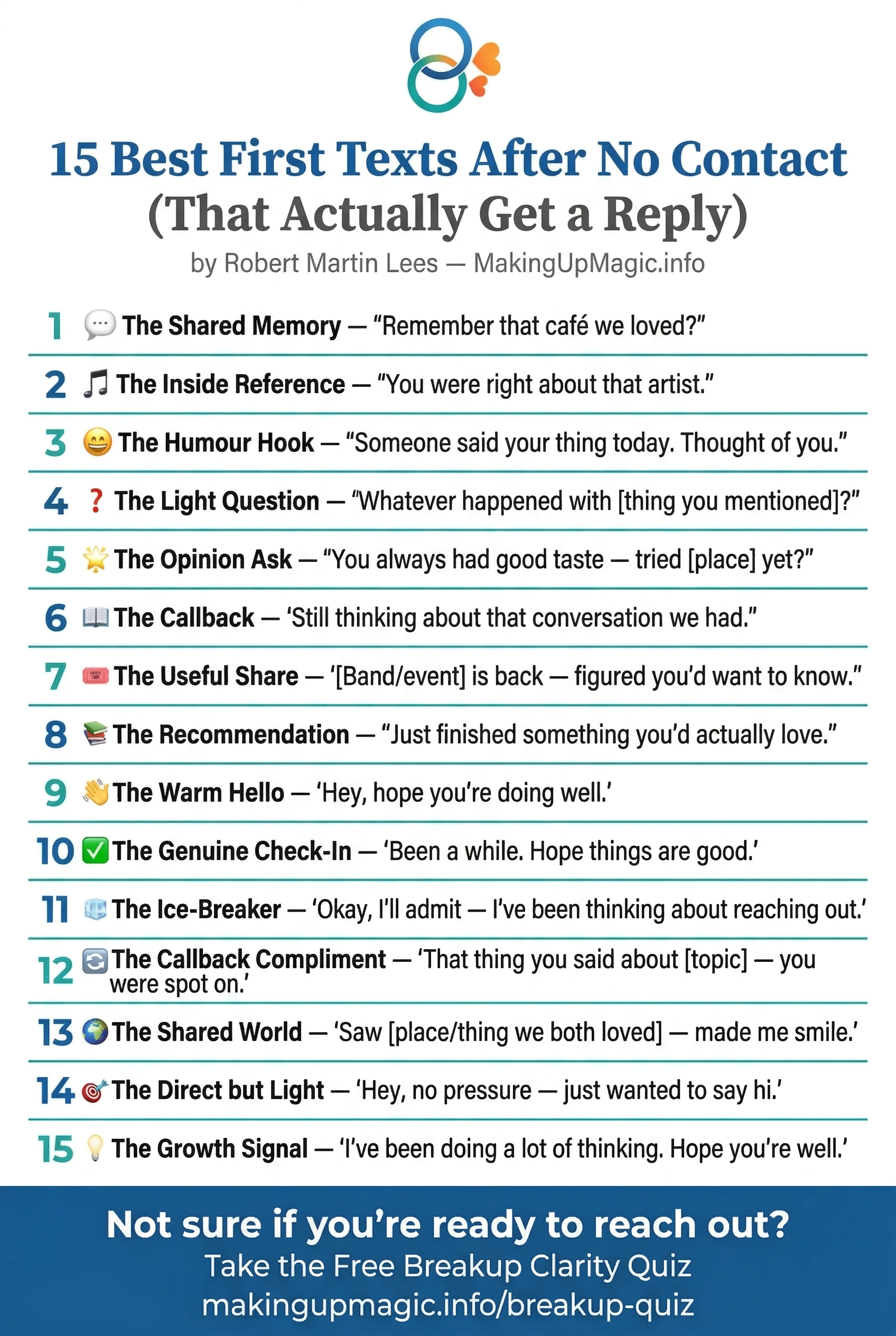
Want the full texting system? These 15 examples are a strong start — but if you want the complete psychological framework for what to say at every stage of reconnection, Text Your Ex Back by Michael Fiore is the most structured texting program I’ve reviewed. It goes far beyond openers — it maps the entire conversation arc from first contact to rebuilding attraction.
Affiliate link — I only recommend tools I’ve personally tested and would share with a close friend. Check Out My Does text Your Ex back work review
Texting an Avoidant Ex After No Contact
If your ex has an avoidant attachment style, the standard playbook needs adjusting. Avoidants don’t respond well to emotional pressure — even subtle pressure. They need to feel like reaching back is their idea.
Here’s what changes:
- Go even lighter. Texts 6, 8, and 12 from the list above are your best options — value drops and interest-based callbacks with zero emotional weight.
- Shorter is better. One sentence. Maybe two. Avoidants feel crowded by long messages.
- Don’t follow up quickly. If they don’t reply within a few days, wait. Chasing an avoidant triggers their withdrawal reflex.
- No “we need to talk” energy. Ever. Even implied.
Understanding the push-pull dynamic of avoidant attachment is one of the most important things you can do right now. My deep-dive on the anxious avoidant trap explains exactly why this pattern plays out — and how to break it.
Who Should Text First After No Contact?
This is one of the most searched questions — and the answer is simpler than you think.
If you initiated no contact: you text first. You set the silence. You end it.
If they initiated the breakup: you still text first — but only after you’ve genuinely done the inner work. Not to prove something. Not out of desperation. Because you’re ready to reconnect from a place of calm, not need.
If they’ve already reached out during no contact: that changes everything. Read my guide on what to do if your ex contacts you during no contact before you respond.
The bottom line: waiting for them to text first is a passive strategy that rarely pays off. You’ve done the work. You’re grounded. You go first — with intention.
The Psychology Behind Why These Texts Work
There’s real science behind why low-pressure re-entries outperform emotional confessions.
Research published in Current Psychology (Springer, 2025) found that anxious attachment styles are significantly linked to higher breakup distress — and that emotional intensity matters far more than relationship length. Your brain doesn’t care about the calendar. It cares about how deeply it bonded. That’s why the pull to send a big emotional text feels so overwhelming — and why resisting it is so powerful.
Two psychological principles are working in your favour when you send a calm, curiosity-driven text:
1. Psychological Reactance. When people feel free to choose, they’re more likely to engage. A low-pressure text gives your ex full autonomy — no obligation, no guilt. That freedom makes them more likely to reply, not less.
2. The Curiosity Gap. A positive memory reference or open-ended question plants a seed that compels a reply simply to close the loop. Done right, they reach back without feeling manipulated — because they’re not being manipulated. They’re just curious.
Want to go deeper on the attraction psychology? My article on the psychology to make your ex miss you covers the full framework.
Texts You Should Never Send After No Contact
Knowing what not to send is just as important as the examples above. These are the messages that undo weeks of progress in seconds:
- “I still love you and I can’t stop thinking about you” — Comes off as desperate. Puts enormous pressure on them before any trust is rebuilt.
- A wall of text — Emotional overload. They’ll skim it, feel overwhelmed, and pull back.
- “We need to talk” — Triggers defensiveness immediately. Nobody wants to feel summoned.
- The drunk text — Signals you haven’t done the work. Undermines everything no contact was building.
- The guilt trip — “I’ve been really struggling since you left.” Even if true, this is pressure dressed as vulnerability.
- The indirect test — “Just checking if you’re still alive lol.” They can feel the agenda behind it.
For a full breakdown of what derails reconnection, read my guide on mistakes to avoid when trying to get your ex back.
What To Do After They Reply
This is where most people blow it. A reply comes in and suddenly the floodgates open — feelings, questions, “so where do we stand?”
Don’t.
Mirror the tone. If they keep it casual, you keep it casual. If they lean warm and engaged, you build slowly from there. Match their energy — don’t exceed it.
Think of it like texting a friend you haven’t spoken to in a while. Ease in. Let the conversation breathe. Your goal in the first exchange is simply to establish that contact is welcome — nothing more.
From there, the next layer is building genuine momentum — playful banter, shared references, and eventually the kind of emotional honesty that feels earned rather than forced. My guide on texts to make your ex miss you covers exactly how to build that momentum after the door reopens.
And if you’re serious about having a complete system — not just individual texts but a full reconnection roadmap — the best programs to get your ex back page compares every major option so you can choose what fits your situation.

Robert Martin Lees — Relationship Coach & Author
Robert’s authority isn’t academic — it’s earned through lived experience: a marriage that nearly collapsed, a cycle of love and loss that started in childhood, and the slow, unglamorous work of becoming someone worth loving. He writes to help others break the patterns that keep them stuck. Read his full story here.
Frequently Asked Questions
What is the best first text to send after no contact?
The best first text is short, warm, and curiosity-driven — not emotional or demanding. A shared memory reference, a light callback, or a value drop consistently outperforms emotional confessions. Keep it under two sentences and leave natural room for them to reply.
How long should no contact be before texting?
Most effective timelines fall between 21–45 days depending on relationship length and breakup intensity. Short relationships: 21–30 days. Long-term or high-conflict breakups: 30–45 days. The goal is for both of you to have genuinely reset — not just waited out a timer.
What should I say in my first text after no contact?
Reference something positive and shared — a memory, a mutual interest, something they recommended. Avoid anything that references the breakup, the silence, or your feelings. The first text is a reintroduction, not a reconciliation attempt.
What if my ex doesn’t reply to my first text?
Don’t panic — and don’t follow up immediately. Silence doesn’t always mean rejection. Wait at least a week before trying once more with a different, equally light message. If they ignore two respectful attempts, shift your focus back to your own healing and growth.
Should I text my ex first after no contact, or wait for them?
If you initiated no contact, you should text first — you set the silence, you end it. Waiting passively for them to reach out is a low-probability strategy. Go first, but go calmly and without agenda.
How do I text an avoidant ex after no contact?
Go lighter than you think you need to. One sentence. A value drop or shared interest callback with zero emotional weight. Avoidants need to feel like replying is entirely their choice — any hint of pressure triggers withdrawal. Give them full autonomy and let them come to you.
Can I say “I miss you” in my first text after no contact?
Not in your first message. Emotional confessions before trust is rebuilt almost always backfire. Start light and casual — save honest emotional expression for when the connection has naturally reopened and the conversation has warmed up.
What are triggering texts to send after no contact?
In a positive sense, “triggering” texts activate emotional memory — shared experiences, inside references, or callbacks to things they love. The Memory Trigger and Humor Hook examples above are designed exactly for this. They spark a feeling before a thought, which is what makes them effective.
📋 Not sure if you’re ready to reach out? Take the 60-second Breakup Clarity Quiz — it’ll tell you exactly where you stand and what your best next move is.





Reading this as a Gen X guy made me realize how different dating communication has become. When I was younger, if you wanted to reconnect with someone after a breakup you usually picked up the phone or talked face-to-face, and texting wasn’t really part of the equation.
It’s interesting seeing how much strategy and psychology now goes into something as small as a single text message. The idea of keeping it short, light, and pressure-free actually makes a lot of sense, especially the part about not sending a wall of emotional messages right away.
From my perspective, it almost feels like texting has become its own language with rules and signals that didn’t exist years ago. Articles like this are helpful because they explain the thinking behind it instead of just giving canned lines.
One thing I’m curious about though: do you think texting has actually made reconnecting after a breakup easier, or does it sometimes make things more complicated because people can overthink every word?
Jason, I love this perspective. You’re absolutely right—the ‘rules’ have changed, and for those of us who remember a time before smartphones, the modern ‘texting game’ can feel like a foreign language.
To answer your question: I think texting has made it both easier and more complicated. It’s easier because it lowers the ‘barrier to entry’—it’s much less intimidating to send a 10-word text than to make a phone call. But you hit the nail on the head regarding the complication: overthinking.
Because a text is static, we tend to project our own fears and anxieties into the ‘white space’ between the lines. That’s why I advocate for keeping things ‘short, light, and pressure-free.’ The goal isn’t to have a deep conversation over text; it’s simply to signal that the door is open and you’re a safe person to talk to. If you find yourself overthinking every comma, that’s usually a sign to put the phone down and check in with your own ‘Breakup Clarity’ first.
Thanks for the great question, Jason. It’s a reminder that while the technology changes, the human need for genuine, low-pressure connection stays the same.
Best,
Robert