<
You can feel it — the way they looked at you, the history you shared… it couldn’t have been fake, right? But if your ex really loved you, why haven’t they come back yet? That question eats away at your peace. Here’s the real truth.
I remember the moment it hit me — not the breakup itself, but about three weeks later. I was standing in the supermarket, and a song came on over the speakers. One of our songs. And I just stood there, frozen in the cereal aisle, trying not to fall apart in public.
 That’s when I realized: these feelings weren’t going anywhere on their own. They weren’t a sign of weakness. They were a sign that something real had existed — and that my mind and body were still processing the loss of it.
If you’re asking whether feelings last after a breakup, the honest answer is: yes, they do — and there’s a reason for that. Understanding why is the first step to moving through them rather than being stuck in them.
📋 In This Guide
- Why Feelings Last After a Breakup (The Neuroscience)
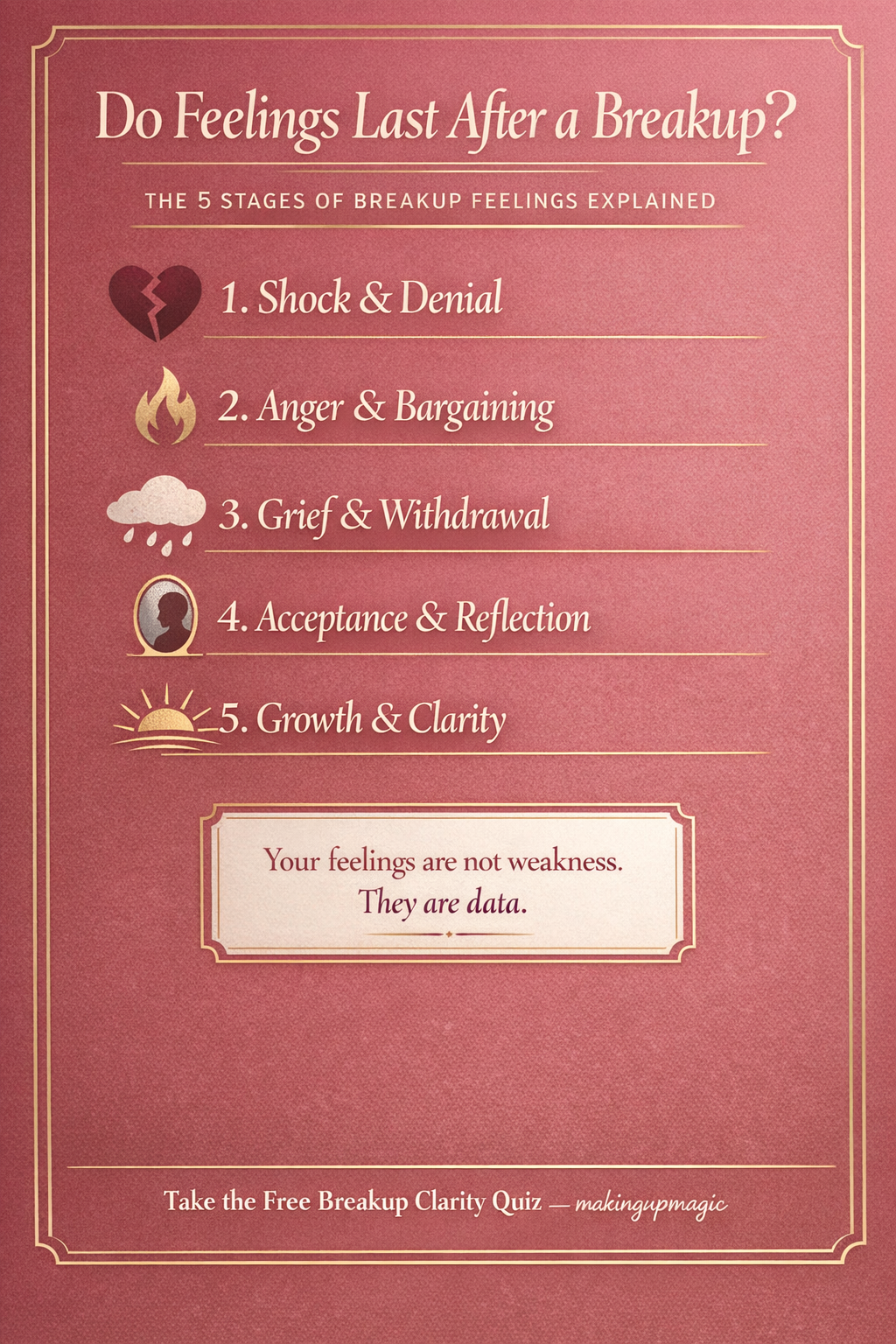
- The 5 Stages of Feelings After a Breakup
- How Long Do Breakup Feelings Last?
- What Your Feelings Are Actually Telling You
- How to Cope With Feelings After a Breakup
- Do They Still Have Feelings Too?
- Frequently Asked Questions
Why Feelings Last After a Breakup (The Neuroscience)
Here’s something most breakup advice skips entirely: your brain processes romantic love the same way it processes addiction.
Studies using fMRI scans show that when people look at photos of an ex they still love, the same reward centres light up as in cocaine addiction — the dopamine pathways, the nucleus accumbens, the ventral tegmental area. You’re not being dramatic. You’re going through a form of withdrawal.
This is why:
- You keep replaying memories on loop — your brain is searching for the “hit” it’s been cut off from
- You feel physical pain — social rejection activates the same neural pathways as physical injury
- You can’t just “decide” to stop feeling — the emotional brain doesn’t respond to logic the way we wish it would
- Small triggers (a song, a smell, a place) can flood you instantly — because memory and emotion are stored together
Understanding this doesn’t make the pain disappear. But it does make you stop blaming yourself for feeling it.
The 5 Stages of Feelings After a Breakup
These aren’t rigid boxes — you’ll move between them, revisit them, and sometimes feel two at once. But recognising where you are helps you stop fighting the process.
Stage 1: Shock & Denial
“This can’t be real. We’ll sort this out.”
Even when a breakup was expected, the initial shock is real. Your nervous system goes into a kind of protective numbness. You might feel strangely calm — or completely dissociated. This is your brain’s way of buying time to process something it can’t yet absorb.
What it’s telling you: The relationship mattered. The loss is significant. Give yourself permission to feel the weight of that.
Stage 2: Anger & Bargaining
“How could they do this? If I just explain it differently, they’ll understand.”
Anger is grief with somewhere to go. It’s also one of the most misunderstood stages — because it often masks deep hurt and fear. Bargaining is the mind’s attempt to regain control: if I do X, maybe Y won’t be true.
I spent weeks in this stage. I replayed every argument, every moment I could have done differently. I drafted messages I never sent. I convinced myself that if I could just find the right words, I could fix it.
I couldn’t. And that’s not a failure — that’s just how grief works.
What it’s telling you: You haven’t accepted the loss yet. That’s okay. But be careful not to act from this stage — decisions made in anger or bargaining rarely serve you.
Stage 3: Grief & Withdrawal
“I just don’t have the energy for anything.”
This is the stage most people are afraid of — and the one that does the most important work. The sadness, the fatigue, the loss of interest in things you used to enjoy. This is your system processing the full weight of what’s been lost.
It’s not depression (though it can tip into it — watch for that). It’s mourning. And mourning is healthy.
What it’s telling you: You’re processing. Don’t rush this. Don’t numb it with distractions that just delay it.

Stage 4: Acceptance & Reflection
“I’m starting to see this more clearly now.”
Acceptance doesn’t mean you’re okay with what happened. It means you’ve stopped fighting the reality of it. This is where genuine reflection becomes possible — where you can start to see the relationship honestly, not just through the lens of loss.
What it’s telling you: You’re ready to learn from this. What patterns do you want to carry forward? What do you want to leave behind?
Stage 5: Growth & Clarity
“I know who I am now in a way I didn’t before.”
This is the stage the Cycle Breaker framework is built around. Not just “getting over it” — but genuinely growing through it. The people who reach this stage don’t just heal from the breakup. They come out of it with a clearer sense of self, stronger boundaries, and a more honest understanding of what they need in a relationship.
What it’s telling you: You’re ready. Whether that means reconnecting with your ex from a place of genuine strength — or moving forward into something new.
How Long Do Breakup Feelings Last?
The timeline depends on:
- Relationship length and depth — longer, more intertwined relationships take longer to process
- Attachment style — anxious attachers tend to feel the acute pain more intensely; avoidants often feel it later
- Whether there was closure — ambiguous endings (no clear reason, mixed signals) prolong the process significantly
- What you do during the healing period — active processing (journaling, therapy, honest reflection) shortens the timeline; numbing and avoidance extends it
What Your Feelings Are Actually Telling You
This is the part most breakup content misses entirely.
Your feelings after a breakup aren’t just pain to be managed. They’re data. They’re your emotional system communicating something important about your needs, your patterns, and your values.
- Obsessive thoughts about your ex → Often signal unresolved attachment, not necessarily that they’re “the one”
- Anger that won’t shift → Usually points to a boundary that was crossed and never addressed
- Grief that feels disproportionate → May be compounded grief — this loss triggering older, unprocessed losses
- Fear of being alone → Points to anxious attachment patterns worth understanding before the next relationship
- Relief mixed with sadness → A sign the relationship had real problems, even if the love was genuine
Learning to read your feelings rather than just react to them is one of the most powerful things you can do — both for your healing and for understanding whether your ex still carries feelings too.
How to Cope With Feelings After a Breakup
1. Name What You’re Feeling (Specifically)
“I feel bad” keeps you stuck. “I feel abandoned and scared that I’m not enough” gives you something to work with. Emotional granularity — the ability to name feelings precisely — is directly linked to faster emotional recovery.
2. Stop Fighting the Waves
Grief comes in waves. Fighting a wave exhausts you. Riding it — letting it come, feeling it fully, knowing it will pass — is what actually moves you through it. The wave that you resist tends to persist.
3. Create Structure, Not Distraction
There’s a difference between healthy routine (exercise, sleep, meaningful work) and numbing distraction (endless scrolling, rebound relationships, staying constantly busy). One processes the pain. The other delays it.
4. Audit Your Inputs
What you consume during this period matters enormously. Stalking their social media keeps the wound open. Consuming content that validates your worst fears amplifies them. Be intentional about what you let in.
5. Use the Feelings as a Map
Every strong feeling is pointing at something. Use this period to understand your attachment patterns, your relationship needs, and the cycles you want to break. This is the Cycle Breaker work — and it’s what separates people who grow from this from people who just survive it.
Do They Still Have Feelings Too?
Almost certainly — yes. The same neuroscience applies to both people. Love doesn’t switch off at the moment of a breakup. What changes is the decision about what to do with those feelings.
Your ex may be:
- Suppressing feelings behind pride or ego
- Processing at a different pace (avoidants often feel the loss later)
- Confused by their own mixed emotions
- Waiting to see what you do next
Whether those feelings translate into action depends on timing, personal growth, and how the reconnection is handled. For a deeper look at whether your ex is likely to come back, see: Will My Ex Come Back?
💌 Not Sure What Your Feelings Are Telling You?
The 60-second Breakup Clarity Quiz cuts through the noise and gives you a personalised read on where you are — and what your clearest next move is.
When you’re ready to think about reconnection, the way you re-open communication matters enormously. Text Your Ex Back gives you the framework for doing that from a place of emotional clarity — not desperation.
Frequently Asked Questions
How to cope with feelings after a breakup?
Name your feelings specifically, stop fighting the emotional waves, create healthy structure (not just distraction), audit what you’re consuming, and use the feelings as a map to understand your patterns. Active processing always shortens the timeline compared to avoidance.
What are the stages of feelings after a breakup?
Most people move through five stages: Shock & Denial, Anger & Bargaining, Grief & Withdrawal, Acceptance & Reflection, and Growth & Clarity. These aren’t linear — you’ll move between them — but recognising which stage you’re in helps you stop fighting the process.
How long do breakup feelings last?
Research suggests acute pain eases within 3–6 months for most people. Emotional residue can last longer — particularly after long-term relationships or ambiguous endings. The timeline shortens significantly with active, intentional processing.
Why do breakup feelings feel physical?
Because they are. Social rejection activates the same neural pathways as physical pain. Romantic love also activates dopamine reward circuits similar to addiction — meaning a breakup is, neurologically, a form of withdrawal. The physical symptoms are real, not imagined.
Do feelings after a breakup ever fully go away?
The acute pain does. What often remains is a softer emotional memory — not pain, but a recognition of what was real. Most people find that once they’ve genuinely processed the loss, they can think about their ex without the emotional charge that once came with it.
Can you still love your ex after moving on?
Yes. Love and the decision to move forward aren’t mutually exclusive. Many people carry genuine affection for an ex long after the relationship ends — particularly when the relationship was meaningful and the split wasn’t toxic. Moving on doesn’t erase what was real.
What are common feelings during a breakup?
Shock, disbelief, sadness, anger, guilt, relief, loneliness, anxiety about the future, obsessive thinking, and physical fatigue are all extremely common. Experiencing several of these simultaneously — or cycling between them — is completely normal.
Is it normal to feel worse before you feel better after a breakup?
Yes — and it’s actually a good sign. The grief stage often feels like the lowest point, but it’s where the deepest processing happens. Feeling worse before better usually means you’ve stopped numbing and started actually moving through it.
Take the free 60-second quiz and get a personalised path forward.Take the Breakup Clarity Quiz →