
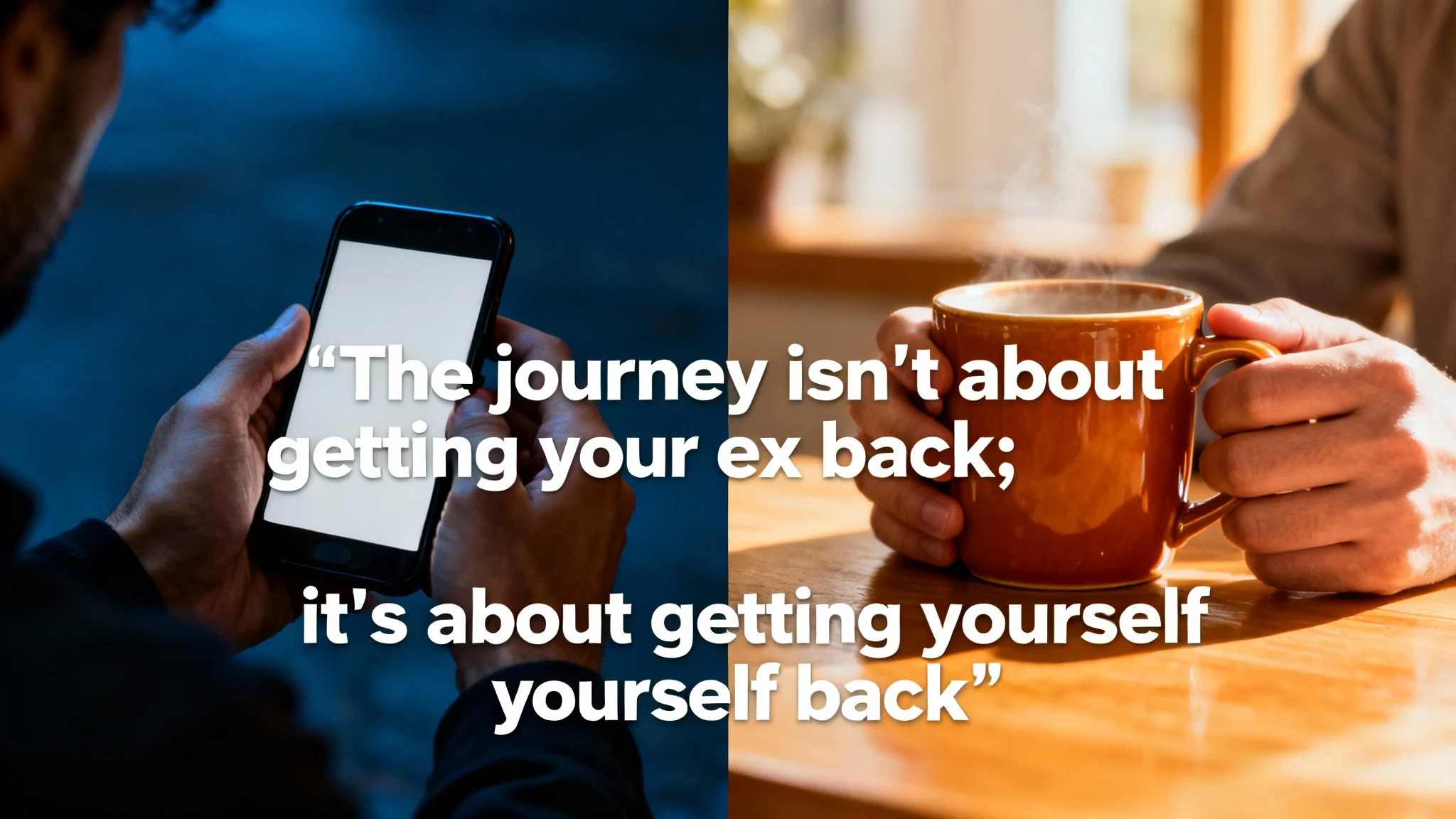
Getting your ex back in 2026 is both easier and harder than it’s ever been. Easier because you have more tools, frameworks, and knowledge than any generation before you. Harder because so does everyone else — including your ex. What still wins? The same thing it always has: becoming someone worth choosing. This article shows you the full picture — where we’ve been, where we are, and what actually works.
You know what nobody tells you when you’re sitting there at 2am, phone in hand, re-reading the last conversation for the fifteenth time?
They don’t tell you that millions of people have sat in that exact same spot. Different phones. Different decades. Same ache.
I’ve been there. And I’ve spent years helping people navigate what comes next — not just the tactics, but the truth underneath the tactics.
Here’s what I’ve noticed: the way people try to get their ex back has changed more in the last two years than in the previous twenty. And most people don’t realize how much that matters — or how much it doesn’t.
So let’s talk about it. The real story. The full timeline. And what it means for you right now, in 2026.

Before the Internet — When Dignity Was the Only Strategy
Picture this: it’s 1987. You just broke up with someone you loved. What do you do?
You call a friend. Maybe you cry in your car. If you were really motivated, you drove to the library and found a self-help book with a cracked spine that someone else had already dog-eared in desperation.
There was no Google. No forums. No one to tell you what “no contact” meant or why it worked. You either had the wisdom of someone older who’d been through it — a parent, a mentor, a pastor — or you had your gut.
And here’s the thing I’ve come to deeply respect about that era: people had to sit with their pain. There was no scrolling to numb it. No algorithm to distract you. You either processed it or you didn’t.
The ones who got their person back — or found something better — did it through one thing: dignity. They stopped chasing. They got on with their lives. They became someone worth coming back to.
“Think of yourself as a gardener. You can’t force a flower to bloom by pulling at its petals. You prepare the soil, you tend to yourself, and you trust the season.” — Robert Martin Lees
That gardener wisdom? It didn’t come from a program or an AI. It came from watching what actually worked across generations. And it still works today.
The Internet Arrives — Finally, Someone Gets It
Then the internet happened. And for the first time, heartbroken people could find each other.
Forums appeared. Articles. Strangers who’d been through exactly what you were going through, sharing what helped and what made it worse. For millions of people, this was the first time they had language for their pain.
“No contact.” “Attachment styles.” “Rebound relationships.” These weren’t new concepts — but suddenly they were searchable. Findable. Shareable.
The relief was real. You weren’t crazy. You weren’t alone. There was a name for what you were feeling and a framework for what to do next.
But information overload arrived right alongside it. Contradictory advice everywhere. “Text them immediately.” “Never text first.” “Make them jealous.” “Be vulnerable.” The noise was deafening.
And that’s when the next evolution began.
The Program Era — Frameworks, Hope, and a Few Traps
The Magic of Making Up. Text Your Ex Back. His Secret Obsession. The Ex Factor Guide.
If you’ve been researching how to get your ex back for more than five minutes, you’ve probably encountered at least one of these. And here’s my honest take after years of reviewing them:
The good ones gave people something the internet couldn’t: a structured path through the chaos.
Instead of 47 contradictory articles, you had one system. Step one, step two, step three. A framework built on real psychology — attachment theory, emotional triggers, the science of attraction and reconnection.
That structure matters. When you’re in the fog of heartbreak, your prefrontal cortex — the part of your brain that makes rational decisions — is genuinely impaired. You need a map. The best programs provided one.
The trap? Some people started treating their ex like a puzzle to solve rather than a person to love. The tactics became the point, instead of the relationship.
I still recommend the right programs to the right people. If you want to know which ones I trust, start with my guide to the best programs to get your ex back — I break down exactly what works and what’s just marketing.
But programs are tools. And a tool is only as good as the person holding it.
Social Media Changes Everything — And Not Always for the Better
Then came Instagram. Snapchat. TikTok. And everything got harder.
Now you could watch your ex’s Stories at 2am. See who liked their photos. Notice they were out on a Friday night when they told you they needed space. Analyze a single emoji for forty-five minutes.
I’m not exaggerating. I’ve talked to people who’ve done exactly that.
Social media introduced a new category of post-breakup pain: digital surveillance. And with it came a new category of mistakes — reactive posting, jealousy tactics, the “accidental” story view, the subtly pointed caption.
It also introduced something called orbiting — where your ex stays just close enough digitally to keep you emotionally hooked, without any real intention of reconnecting. If you’ve experienced this, you know how destabilizing it is.
The signs your ex is pretending to be over you became a whole new category of confusion in the social media era. Because now you had data — but data without context is just noise dressed up as signal.
“Imagine you’re crossing a desert after a breakup. The mirages are the social media posts, the late-night story views, the breadcrumbs. The oasis — the real one — is on the other side of your own healing.” — Robert Martin Lees
The antidote to social media chaos? The same thing it’s always been. No contact — real no contact, not “no contact except I check their profile seventeen times a day” — remains the most powerful reset available to you.

The AI Era (2025–2026) — Smart Tools, Same Heart
And now we’re here. 2026.
Young people are opening ChatGPT at midnight and typing: “My ex sent me ‘k’ after I apologized. What does that mean?”
They’re using AI to decode texts, draft responses, analyze their ex’s behavior patterns, and build reconciliation strategies. And honestly? Some of it is genuinely useful.
AI can help you understand attachment theory faster than any book. It can help you draft a thoughtful message when your brain is too flooded with cortisol to think straight. It can give you frameworks, language, and perspective at 3am when no human friend is available.
But here’s what AI cannot do:
- It cannot feel your specific attachment wound
- It cannot know the history between you and this particular person
- It cannot hear God’s timing in your situation
- It cannot replace the lived wisdom of someone who has actually been through it
I’ve seen people get so sophisticated in their AI-assisted strategy that they completely lost the plot. They were optimizing their approach while forgetting to actually heal. They were outsmarting themselves right out of the relationship they wanted.
The smartest use of AI in 2026 is as a research and reflection tool — not a replacement for genuine self-work. Use it to understand yourself better. Use it to find language for what you’re feeling. Then put the phone down and do the actual work.
And if you want to know where to start that work, the fastest path to winning your ex back still begins with the same foundation it always has.
Speaking of which — this is also where I’ll be transparent with you. We’re building something new at Making Up Magic: a course and AI-integrated coaching tool that combines the best of both worlds. Real wisdom, real frameworks, real human experience — with AI that actually knows your situation because you’ve told it. More on that soon. But the foundation of everything we’re building is the same truth that’s always been true.
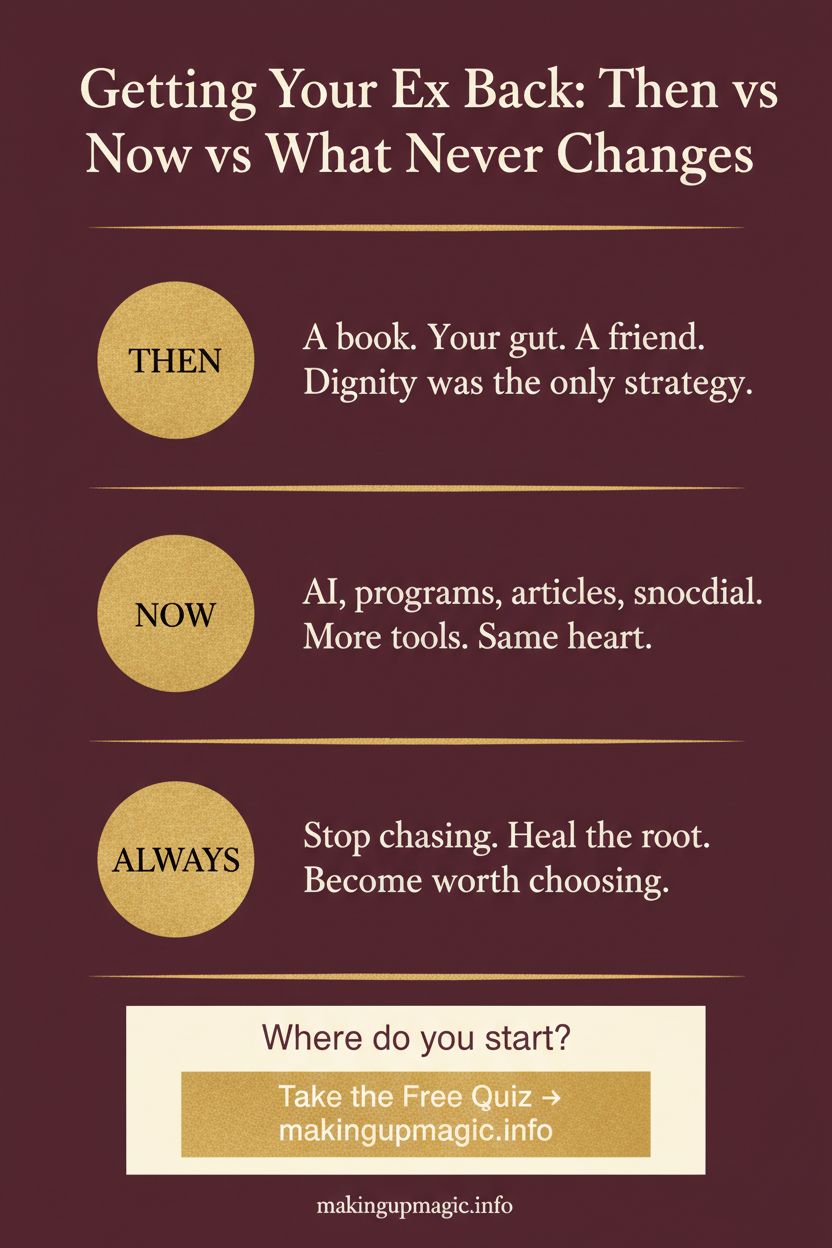
What Never Changes — The Constant Across Every Era
Here’s what I’ve observed across every era, every tool, every generation of heartbreak:
The people who got their ex back — or found something better — did the same things.
1. They Stopped Chasing
Not because they stopped caring. Because they understood that pursuit without attraction is just pressure. And pressure pushes people away. Every time. In every era.
The no contact guide isn’t a trick. It’s a reset. It gives both people space to feel the absence — and absence, when there’s real love underneath, does something that no text or strategy can replicate.
2. They Healed the Root
Not the surface. Not “I’ll just be nicer this time.” The actual root — the pattern, the wound, the thing that kept showing up in the relationship and eventually broke it.
This is where self-improvement after a breakup becomes more than a cliché. It becomes the actual strategy. Because your ex fell in love with a version of you. The question is: are you becoming more of that person, or less?
3. They Showed Up as Someone Worth Choosing
Not perfect. Not performing. Just genuinely better — calmer, clearer, more grounded in who they were and what they wanted.
This is the Captain principle. A captain doesn’t abandon the ship when the storm hits. They steady themselves, navigate with clarity, and inspire confidence — not through force, but through presence.
When you show up that way, you don’t have to convince your ex of anything. They feel it.
4. They Knew When to Reach Out — and How
Timing and tone are everything. The right text after no contact can open a door that seemed permanently closed. The wrong one — sent too soon, too desperate, too clever — can close it for good.
And if you’re wondering whether to reach out at all, start with the complete texting your ex guide — it covers every scenario I’ve encountered across years of coaching.
Your Next Step Right Now
If you’ve read this far, you’re not just looking for a quick fix. You’re looking for something real.
Good. That’s exactly who this is for.
Here’s what I want you to do next: don’t try to figure out your entire situation in one sitting. That’s not how healing works, and it’s not how reconciliation works either.
Start with one honest question: Where am I actually at right now?
Not where you wish you were. Not where you think you should be. Where you actually are.
If you’re not sure, the 60-second Breakup Clarity Quiz was built for exactly this moment. It’ll give you a clear read on your situation and a personalized next step — not a generic one.
Not sure where to start?
Take the free 60-second Breakup Clarity Quiz and get your personalized next step.
And if you want to go deeper right now, here are the most important reads depending on where you are:
- Just broke up: Does No Contact Work? The Complete Guide
- Wondering if there’s still hope: Will My Ex Come Back?
- Ready to reach out: What to Text Your Ex After No Contact
- Want a full program: Best Programs to Get Your Ex Back (Honest Review)
- Unsure if it’s too late: When Is It Too Late to Get Your Ex Back?
FAQ — Real Questions, Real Answers
Is it actually possible to get my ex back in 2026?
Yes — but the honest answer is that it depends on the specific situation, the reason for the breakup, and most importantly, whether both people are willing to grow. What I can tell you is that the fundamentals of reconciliation haven’t changed: genuine self-improvement, strategic space, and authentic reconnection still work in 2026 exactly as they did before the internet existed.
Should I use AI to help get my ex back?
AI can be a useful research and reflection tool — helping you understand attachment patterns, find language for your feelings, or draft a thoughtful message. But it cannot replace lived wisdom, genuine healing, or the nuance of your specific relationship. Use it as a support tool, not a strategy engine. The best results come from combining AI-assisted insight with real human guidance.
What is the biggest mistake people make when trying to get their ex back in 2026?
Over-strategizing while under-healing. In 2026, people have access to more tactics, scripts, and frameworks than ever before — and many use them to avoid doing the actual inner work. The biggest mistake is optimizing your approach while neglecting the root cause of the breakup. Your ex doesn’t need a perfectly crafted text. They need to feel a genuine change in who you’re becoming.
Do relationship programs like The Ex Factor or Magic of Making Up still work in 2026?
The best ones do — because they’re built on psychology that doesn’t change with technology. Attachment theory, emotional triggers, the science of attraction and reconnection — these are human constants. What’s changed is that you now have more context to evaluate them. I recommend reading my honest breakdown of the best programs to get your ex back before investing in any of them.
How long does it take to get your ex back in 2026?
There’s no universal timeline — it depends on the length of the relationship, the reason for the breakup, and how both people respond to space and growth. Most genuine reconciliations happen between 30 and 90 days after consistent no contact and visible personal change. For a detailed breakdown, see the full guide on how long it takes to get your ex back.
What’s the first thing I should do if I want my ex back right now?
Stop. Breathe. Don’t send that text yet. The first move is almost always to create space — for both of you. Start with the no contact guide to understand why this works and how to do it properly. Then take the Breakup Clarity Quiz to get a personalized read on your specific situation. One step at a time.
About the Author
 Robert Martin Lees is a relationship coach, writer, and the founder of Making Up Magic. He has spent years helping people navigate heartbreak, reconciliation, and the deeper work of becoming someone worth loving — drawing on lived experience, faith, and a deep respect for the complexity of human connection. His approach blends practical strategy with psychological insight and the kind of honest, grounded wisdom that only comes from having been through it yourself.
Robert writes from the belief that the journey back to your ex is, at its core, a journey back to yourself — and that both are worth taking seriously.





Hey Robert,
Thoughtful take on a tender topic. From my own experience, the most productive first step wasn’t a grand gesture—it was a quiet reset: no-contact for a bit, therapy or journaling to see my part clearly, then a calm check-in only if I could accept either outcome. Two questions to deepen the convo: how do you help people decide whether they truly want reconciliation or just relief from pain? And if both parties are open to talking, do you recommend a structure for that first conversation (time limit, topics, boundaries) so it doesn’t spiral out of control?
Marios
Hey Marios,
Thank you for this incredibly thoughtful comment. You’ve hit on the absolute heart of the matter, and your wisdom about being able to “accept either outcome” is the foundation of true healing and strength. I appreciate you sharing that.
You’ve asked two profound questions that get to the core of a healthy, faith-led approach. Let me do my best to answer them.
1. How do you decide between wanting true reconciliation and just wanting relief from pain?
This is the most important discernment a person can make. Relief is a feeling, but reconciliation is a covenant. One is about soothing the self, the other is about building a future.
Here’s the test I guide people through, a “stillness test” to find the truth:
The Nostalgia Test: Are you replaying a highlight reel of the good times? Or are you looking at the whole picture—the patterns, the hard days, the root issues—and believe you both have the tools to fix what was broken? Relief lives in nostalgia; reconciliation lives in reality.
The “Empty Chair” Test: Sit quietly and imagine your life, peaceful and whole, six months from now. Now, imagine your ex walks in and sits in the empty chair beside you. Does their presence add to your peace, or does it feel like a desperate attempt to fill it? Relief seeks a filler; reconciliation seeks a partner.
The God Test (The Ultimate Litmus): In prayer, ask this: “Lord, is my desire for them pulling me closer to You, or is it a distraction from the healing You’re trying to do in me?” God’s will is never for us to use another person to avoid our own growth. Relief is often an idol; true reconciliation is a partnership that honors Him.
If you’re still wrestling with this, the best tool I can recommend is taking the 60-second Breakup Clarity Quiz. It’s designed to help you uncover your true motivation.
2. What’s a structure for that first conversation so it doesn’t spiral?
You’re right, that first meeting is fragile. The key is to build a “safe container” for the conversation with clear boundaries. The goal is not to solve everything; it’s simply to re-establish a positive, respectful connection.
Here is the structure I recommend:
The Time Limit: Keep it to 60 minutes. A coffee, not a dinner. This lowers the pressure immensely and gives both people an easy, pre-planned exit.
The Territory: Meet on neutral ground. A quiet coffee shop or a park. Avoid your old haunts or either of your homes, which are full of emotional triggers.
The Topic: The stated purpose should be simple: “To catch up.” This isn’t the time to re-litigate the breakup. Avoid blame and focus on “I” statements about what you’ve learned about yourself. If you need a script for that initial outreach, our guide on the first text after no contact can help set the right tone.
The Boundaries (The Non-Negotiables):
No Blame: This is the #1 rule and one of the biggest mistakes people make.
No Alcohol: Stay clear-headed.
No Future-Tripping: Avoid making promises or plans for the future. Stay in the present moment.
Have an Exit Phrase: Agree that if things get tense, either of you can say, “This has been good, but I think this is a good place to stop for today.” It’s an emergency brake that preserves dignity.
Marios, your questions are the kind that lead to real healing, whether that means reconciliation or a healthy new beginning. Thank you again for adding so much value to this conversation.
Blessings,