- Wait until no contact is fully complete before reaching out.
- Your first text should be light, reference a shared memory, and ask nothing heavy.
- Avoid walls of text, apologies, and anything that brings up the breakup.
- Read their reply carefully — it tells you exactly what your next move is.
- If you want a proven word-for-word system, Text Your Ex Back is the most structured program available.
You know that moment when you’ve finally made it through no contact — and now you’re just sitting there, phone in hand, completely blank?
You’ve rehearsed this a hundred times. You know what you want to say. But every time you start typing, something stops you.
I’ve been there. After my own breakup, I spent three days drafting a text I never sent. It was two paragraphs long, covered everything I felt, and would have ended any chance I had before it started.
Here’s what I’ve learned — and what I now teach — about what to text your ex after no contact: the goal of the first text is not to fix everything. It’s just to open a door.
That’s it. One door. Slightly ajar. That’s all you need from message one.
This guide gives you the strategy behind that — the rules, the frameworks, the mistakes to avoid, and how to read whatever they send back. If you want the copy-paste scripts themselves, head to the best first texts after no contact — that’s the companion piece to this one.
But if you want to understand the why behind every word? You’re in the right place.
Is It Actually Time to Text?
Before we talk about what to say, we need to talk about when.
Most people end no contact too early. They hit day 21, feel a surge of confidence, and fire off a text before they’re actually ready. Then they wonder why it didn’t land.
Here’s the honest checklist before you reach out:
- ✅ You’ve completed your agreed no contact period (minimum 21 days, ideally 30–45)
- ✅ You’re not texting from a place of panic, loneliness, or desperation
- ✅ You can genuinely handle a slow reply — or no reply — without spiralling
- ✅ You have something light and natural to reference (a memory, a shared interest, something current)
- ✅ You’ve read the no contact guide and understand what you’re stepping into
If you can check all five — you’re ready. If not, give it a few more days. The text will land better when you’re genuinely calm.
The 3 Rules of a Good First Text After No Contact
Every effective first text after no contact follows the same three principles. Miss one and the whole thing can unravel.

Rule 1: Keep It Light
Your first text is not the place for depth, emotion, or resolution. It’s a casual knock on the door — not a speech. Think of the energy of bumping into an old friend at a coffee shop. Warm, easy, no agenda.
Heavy texts — apologies, declarations, “we need to talk” — trigger defensiveness immediately. Light texts trigger curiosity.
Rule 2: Reference a Shared Connection
The most effective first texts reference something specific to your relationship — a memory, an inside joke, a place, a show you both loved. This does two things: it bypasses the awkwardness of a cold open, and it activates positive emotional memory in your ex’s brain before they’ve even consciously decided how to respond.
Generic texts (“Hey, how are you?”) get generic responses. Specific texts get real ones.
Rule 3: Be Open-Ended
End your text with something that invites a reply without demanding one. A question works — but keep it low-stakes. “Have you been back to [place]?” lands better than “Can we talk?” every single time.
Open-ended = low pressure = higher reply rate.
What to Actually Say — Frameworks That Work
You don’t need a perfect text. You need a good enough text that follows the three rules above. Here are the frameworks I use:
The Memory Spark
Reference something specific and positive from your time together — with zero emotional weight attached.
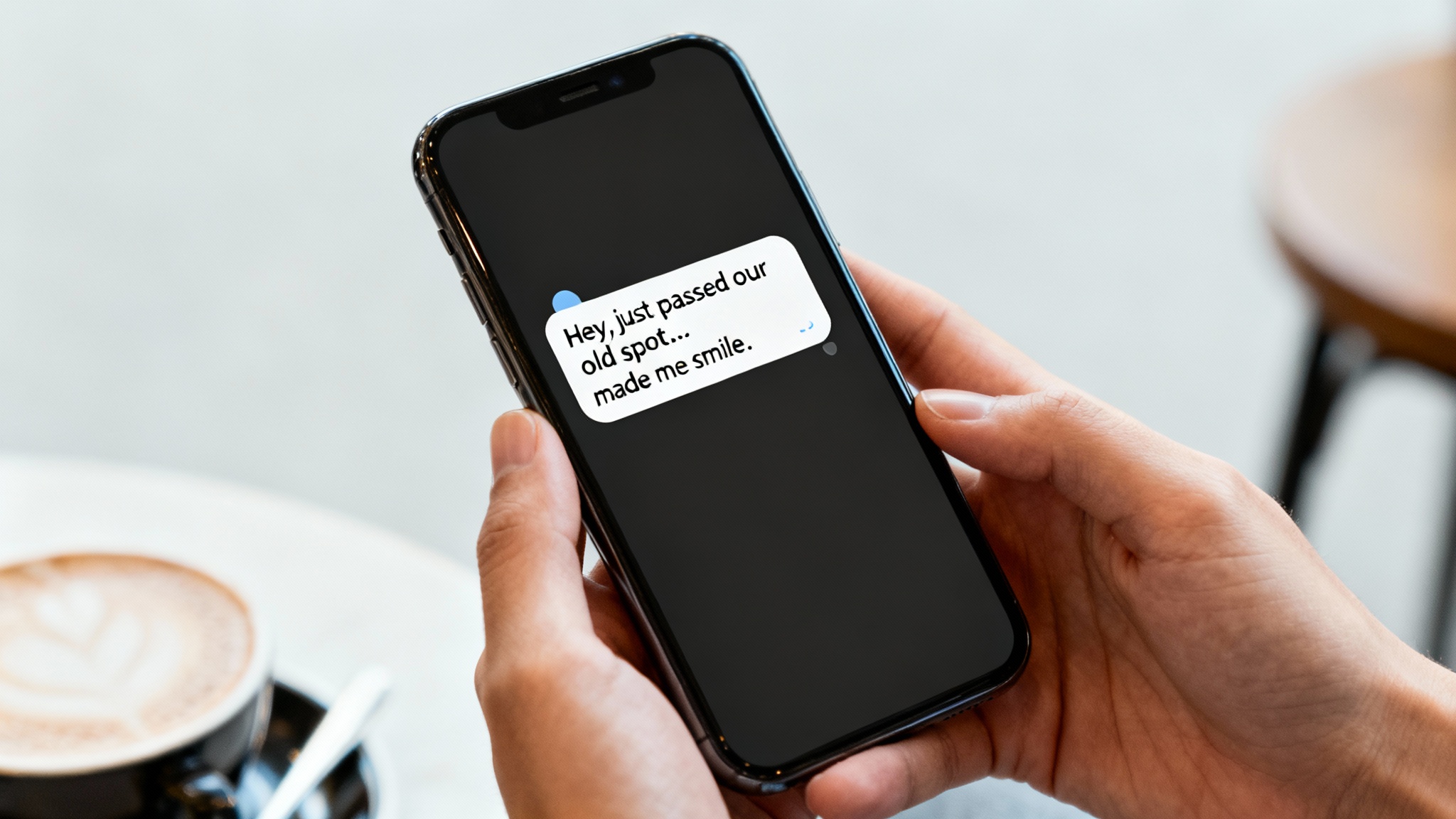
“Just drove past [place we used to go] — made me smile. Hope you’re doing well.”
Short. Warm. No ask. No pressure. Door open.
The Curiosity Hook
Reference something you know they care about — a hobby, a show, a goal they had — and ask a light question about it.
“Random — did you ever end up [thing they were planning]? I was just thinking about it.”
This works because it signals you were thinking of them specifically, not just reaching out blindly.
The Shared Experience Callback
Something in your current life reminded you of something you shared. Natural, honest, no manipulation.
“[Song / movie / thing] just came on and I thought of you. Hope life’s treating you well.”
For 15 ready-to-send examples using these frameworks, see the best first texts after no contact.
3 Mistakes That Kill Your Chances
I’ve seen these three mistakes undo weeks of no contact in a single text. Avoid them completely.
Mistake 1: The Wall of Text
Long texts signal anxiety. They tell your ex you’ve been overthinking this — which makes them feel pressured before they’ve even read the whole thing. Keep your first text to 1–3 sentences. Maximum.
Mistake 2: Bringing Up the Breakup
Any reference to the breakup — even framed positively (“I’ve done a lot of thinking…”) — immediately raises emotional walls. Your ex’s brain goes into self-protection mode. Save that conversation for much later, in person, when trust has been rebuilt.
Mistake 3: Guilt or Pressure
“I miss you so much.” “I’ve been a mess without you.” “I just need to know if there’s still a chance.”
These feel honest. They are honest. But they put the entire emotional weight of the situation onto your ex in the first message — and that’s too much, too soon. It almost always backfires.
For a full breakdown of what not to do across the entire reconciliation process, the mistakes to avoid when trying to get your ex back guide covers it in depth.
Want a Word-for-Word Texting System?
The frameworks above work. But if you want a complete, step-by-step texting roadmap — including exactly what to say at every stage from first contact to getting back together — Text Your Ex Back by Michael Fiore is the most structured program I’ve reviewed.
It’s built specifically around the psychology of post-breakup communication, and it goes far beyond the first text.
How to Analyze Their Reply
This is where most people go wrong after the first text lands. They either over-read a short reply as rejection — or they over-celebrate a warm reply and push too hard too fast.

Reply Type 1: Warm and Engaged
They replied quickly, matched your energy or exceeded it, asked you something back. This is a green light — but don’t accelerate too fast. Keep the next 2–3 exchanges at the same casual level. Let the warmth build naturally.
Reply Type 2: Short and Polite
“Haha yeah.” “I’m good thanks.” “That’s cool.”
This isn’t rejection. It’s caution. They’re not sure yet. Your move: match their energy exactly. Keep it equally brief and light. Don’t try to warm them up with a longer reply — that creates imbalance. Give it a day or two, then send another light message.
Reply Type 3: No Reply
Wait at least 5–7 days before sending a second message. If there’s still no reply after a second attempt, return to no contact for another 2–3 weeks. Silence isn’t always permanent — but chasing it always makes it worse.
Understanding why they’re responding the way they are often comes down to attachment style. If your ex tends to pull away when things get emotional, the anxious-avoidant trap guide explains exactly what’s happening — and how to navigate it.
The Psychology Behind Why This Works
The reason light, specific, open-ended texts work isn’t magic — it’s neuroscience.
When your ex receives a text that references a positive shared memory, their brain activates the same neural pathways associated with that original experience. They don’t just remember the memory — they briefly feel it again. That’s the window you’re working with.
A 2023 study published in Current Psychology found that post-breakup contact that was perceived as low-pressure and non-demanding was significantly more likely to result in positive re-engagement than contact that carried emotional weight or implicit expectations. (Source: Springer, Current Psychology)
In plain terms: calm texts get replies. Desperate texts get blocked.
The psychology of attraction also plays a role here. When you reach out from a place of genuine okayness — not need — you signal value. And that signal matters more than the words themselves. For a deeper dive into this, the psychology to make your ex miss you guide covers the full framework.
What Comes After the First Text
The first text is just the beginning of a longer arc. Here’s how to think about what comes next:
- Exchanges 2–5: Keep it casual. Match their energy. No agenda. Build familiarity back slowly.
- Exchange 6+: Introduce slightly more personal topics — things you know they care about. Still no breakup talk.
- The pivot: When the conversation feels genuinely warm and two-sided, suggest something low-stakes in person — coffee, a walk, something with a natural end time.
- The conversation: Only after you’ve re-established real connection in person do you address what happened between you.
If you want a structured roadmap for this entire arc — not just the texts — the best program to get your ex back guide compares the top options and helps you choose what fits your situation.

Not Sure Where You Stand?
Take the free 60-second quiz and get a personalised read on your situation — including whether reaching out right now is the right move.
 Robert Martin Lees is a relationship coach and the founder of Making Up Magic. After navigating his own painful breakup and rebuilding a relationship he thought was gone for good, Robert has spent years helping others understand the psychology of reconnection — and how to communicate in ways that actually work. His approach blends lived experience with research-backed insight, always focused on empowerment over manipulation.
Frequently Asked Questions
What should I say to my ex after no contact?
Keep it light, specific, and open-ended. Reference a positive shared memory or something you know they care about. Avoid anything heavy — no apologies, no breakup references, no declarations. The goal of the first text is simply to open a door, not walk through it.
How do I text my ex after no contact without seeming desperate?
The key is genuine emotional readiness. If you’re texting from a calm, grounded place — not from loneliness or panic — that energy comes through. Keep the text short (1–3 sentences), don’t over-explain, and don’t follow up immediately if they don’t reply right away.
Can I text my ex after no contact if they haven’t reached out?
Yes — you don’t have to wait for them to go first. In fact, most reconciliations involve one person making the first move. The important thing is that you’ve completed your no contact period and you’re reaching out from a calm, non-desperate place.
How to text an ex after a long time apart?
The longer the gap, the lighter the opener needs to be. A simple callback to a shared memory or a genuine “I was thinking of you” with no pressure attached works well. Avoid referencing the length of time directly — it adds weight you don’t need in message one.
What are the signs an ex wants to reconnect?
Common signs include: they’re watching your social media stories, they like old posts, they reach out on low-stakes occasions (birthdays, shared events), mutual friends mention you to them, or they reply warmly and quickly when you do reach out. For a full breakdown, see signs your ex still cares.
Why is it hard to text an ex after a breakup?
Because the stakes feel enormous. You’re not just sending a text — you’re risking rejection from someone who already knows you. That vulnerability is real. The way through it is preparation: know what you’re going to say, know why it follows the right principles, and send it before you overthink it further.
How do I approach my ex after no contact if things ended badly?
The same rules apply — light, specific, open-ended — but give it more time first. If the breakup was volatile or painful, 45–60 days of no contact is more appropriate than 21–30. When you do reach out, avoid any reference to how things ended. Start completely fresh.
What to text after no contact if they blocked me?
If you’re still blocked, no contact isn’t over yet. Don’t try to reach out through other channels — that almost always backfires. Give it more time, focus on your own growth, and revisit in another 3–4 weeks. Blocking is often a temporary emotional response, not a permanent decision.