
You wake up with that sinking thought: what if each day that passes, they’re forgetting me more? Is there a window where I fade completely? Or do some bonds linger far longer than we think? Let’s unpack what science, psychology, and real experience reveal.
 I remember lying awake at 3 AM running that exact calculation. How many days had it been? Was I fading from her memory the way a song fades from the charts — slowly, then suddenly gone? I was wrong. And if you’re reading this, you probably are too.
📋 In This Guide
- The Psychology of Memory & Attachment
- How to Know If Your Ex Is Forgetting You
- Typical Timelines From Breakup Studies
- The Stages of Forgetting an Ex
- Can You Really Forget Your First Love?
- Factors That Extend or Shorten Forgetting Time
- The Real Fear vs Reality
- What You Can Do Now
- Frequently Asked Questions
The Psychology of Memory & Attachment
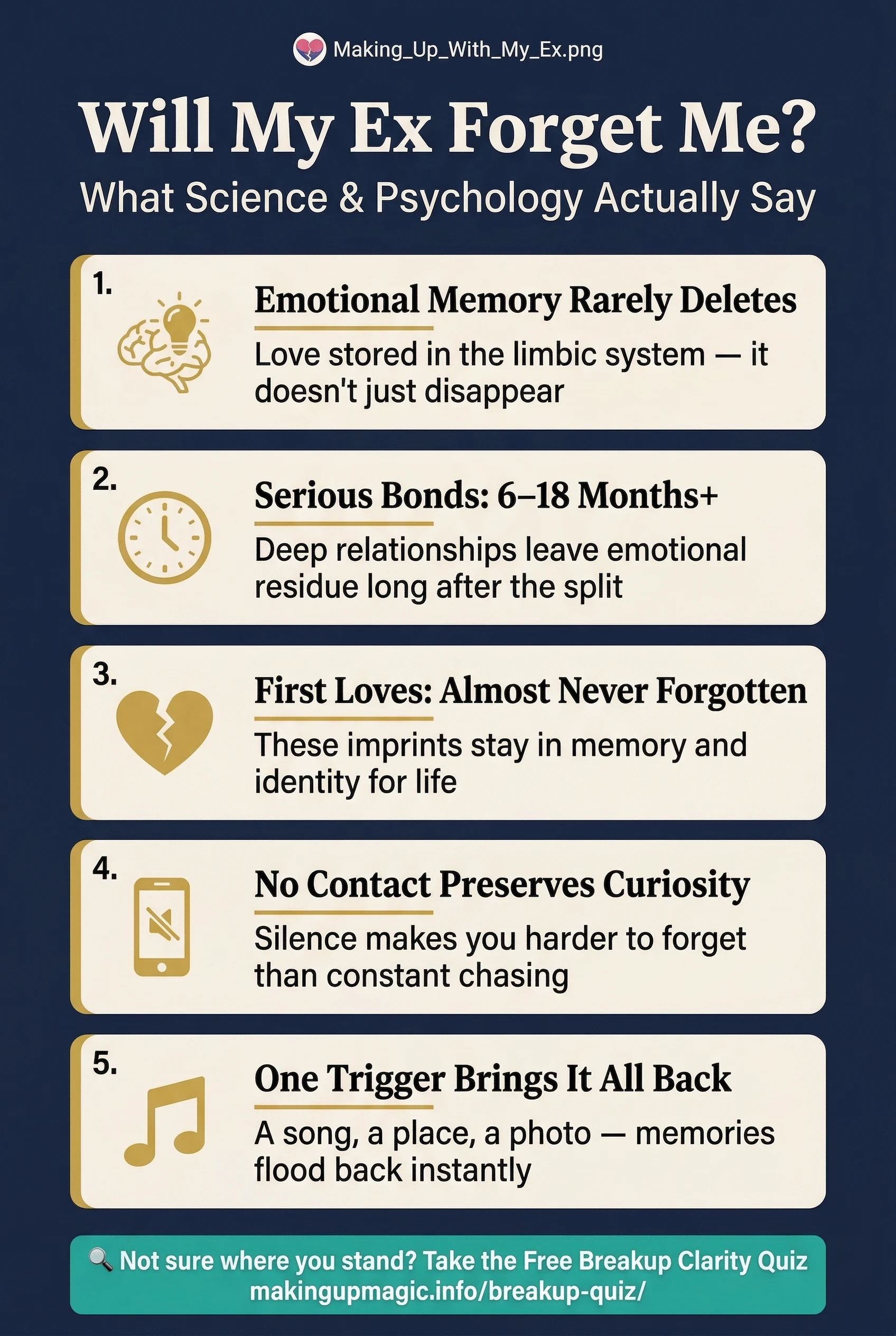
Emotional memory doesn’t work like a delete button. Experiences tied to love and attachment are stored deeply in the brain’s limbic system — the same region that processes fear, joy, and survival instincts. That’s not an accident. Love is wired into us at a biological level.
Even when you’re apart, those shared chapters stay alive in a person’s memory bank — ready to resurface with the right trigger. A song. A smell. A street corner. The brain doesn’t distinguish between “memories I want to keep” and “memories I should delete.” It keeps what mattered.
What is the psychology behind forgetting an ex? Research in attachment theory shows that the stronger the emotional bond, the more deeply encoded the memory. Avoidant partners may suppress those memories more effectively — but suppression isn’t deletion. The feelings are still there, just buried.
For a deeper look at how feelings persist long after a breakup, see: Do Feelings Last After a Breakup?

How to Know If Your Ex Is Forgetting You
This is the question 5,000 people search every month — and most articles skip it entirely. Here are the real signals:
Signs they’re NOT forgetting you:
- They still view your social media stories or posts
- Mutual friends mention your name comes up
- They reach out on significant dates (birthdays, anniversaries)
- They react emotionally when they hear you’ve moved on
- They haven’t blocked you — anywhere
Signs they may be suppressing (not forgetting):
- Complete silence — no contact, no social engagement
- A very fast rebound relationship
- Mutual friends say they “seem fine” but deflect when your name comes up
Suppression and forgetting are not the same thing. Suppression is active — it takes effort. That effort itself is evidence you’re still on their mind.
Want to decode what their behaviour is really signalling? See: 7 Signs Your Ex Still Cares (Even If They’re Silent) and Signs Your Ex Is Pretending to Be Over You
Typical Timelines From Breakup Studies
- Casual / short relationships: Memory fades faster — often weeks to a few months.
- Serious / long-term bonds: Emotional residue can last 6–18 months or more, often years when reminders pop up.
- Powerful “first love” style connections: Almost never forgotten completely.
Surveys show 40–50% of people admit they still think of an ex months or years later. That number climbs significantly when the relationship lasted more than a year or ended without full closure.
For the full reconciliation timeline, see: How Long Does It Take to Get Your Ex Back?
The Stages of Forgetting an Ex
Understanding the stages helps you see where your ex likely is right now — and why “forgetting” is rarely a straight line:
- Raw grief (weeks 1–4): You’re everywhere in their mind. They’re not forgetting — they’re drowning.
- Active suppression (months 1–3): They’re working hard to not think about you. The effort itself keeps you present.
- Distraction phase (months 2–6): New routines, possibly a rebound. Surface-level moving on. Memories still trigger easily.
- Integration (months 6–18+): The relationship becomes part of their story rather than their present pain. They think of you less — but the memory is still there.
- Trigger resurfacing (ongoing): A song, a place, a mutual friend — and it all comes flooding back. This never fully stops for significant relationships.
Can You Really Forget Your First Love?
Short answer: no. And neuroscience backs this up.
First loves are encoded during a period of intense neurological development — typically adolescence or early adulthood — when the brain is forming its core emotional templates. These memories are literally wired differently to later relationships.
Studies show that people can recall their first love with remarkable clarity decades later — names, specific moments, how they felt. Not because they’re still in love, but because those memories are structurally embedded.
If you were someone’s first significant love, you are not forgettable. Full stop.
Factors That Extend or Shorten Forgetting Time
- Length & depth: Longer, more intimate relationships leave stronger imprints.
- Breakup context: Peaceful endings fade easier; messy splits burn into memory longer.
- Rebounds & distraction: New partners can mask old love, but unresolved feelings often resurface.
- Your silence / dignity: Respectful No Contact tends to preserve curiosity and memory — chasing often pushes memories away.
- Shared identity: The more your lives were intertwined — friends, family, routines — the harder the memory is to compartmentalise.
Wondering if No Contact is actually working in your favour? See: Signs No Contact Is Working and Does No Contact Really Work?
The Real Fear vs Reality
The fear: “If I don’t contact them, they’ll forget me.”
The reality: Emotional bonds aren’t erased. Your ex isn’t deleting you like old files. They may simply suppress or distract themselves for a season, but strong attachments leave lasting traces — especially if left unresolved.
I’ve seen this play out in my own life and in the stories of hundreds of people I’ve worked with. The ones who panicked and kept reaching out? They pushed their ex further away. The ones who held their dignity and used the silence to genuinely grow? They became harder to forget — not easier.
As explored in this guide on what healthy love should be, strong relationships leave emotional and psychological imprints that last long after daily communication stops.
Ironically, No Contact often preserves — not erases — memory. Your silence sparks curiosity. It creates a void they feel. That void is you.
What You Can Do Now
Instead of fearing the “forgetting clock,” focus on what you can control:
- Heal and transform during No Contact — become someone worth remembering
- Re-enter communication with dignity and the right words at the right moment
- Use triggers strategically — not desperately
The goal isn’t to stop them forgetting. It’s to be the person they want to remember.
If you’re ready to think about what comes next, start here: Will My Ex Come Back? and The Psychology of Making Your Ex Miss You
💌 Memory Isn’t Gone — It’s Waiting to Be Triggered
Text Chemistry teaches you the exact psychological triggers that reactivate emotional memory and rebuild connection — without desperation or guesswork.
Frequently Asked Questions
Will my ex forget me?
Rarely, if ever, completely. Research shows memories tied to deep love remain accessible for years — especially with triggers like birthdays, music, or familiar places. The more significant the relationship, the more permanent the imprint.
How long before an ex forgets you completely?
For casual relationships, emotional fading can happen within weeks to months. For serious or long-term bonds, emotional residue typically lasts 6–18 months or longer — and for first loves or deeply intertwined relationships, the memory never fully disappears.
How do I know if my ex is forgetting me?
Watch for digital breadcrumbs — story views, reactions, occasional check-ins through mutual friends. Complete silence doesn’t mean forgetting; it often means active suppression, which requires effort and keeps you present in their mind.
Do exes ever forget someone they truly loved?
No. They may move forward, but strong love leaves permanent imprints in memory and identity. Moving on and forgetting are two very different things.
Can No Contact make my ex forget me?
Ironically, No Contact often preserves — not erases — memory. Your silence sparks curiosity and creates a void they feel. Constant chasing is far more likely to push memories away than dignified silence.
What are the stages of forgetting an ex?
Raw grief → active suppression → distraction phase → integration → trigger resurfacing. Most people never fully reach “forgotten” for significant relationships — they simply reach a place where the memory no longer dominates daily life.
Can you really forget your first love?
No — and neuroscience explains why. First loves are encoded during peak neurological development and are structurally embedded in memory. People recall first loves with remarkable clarity decades later.
What is the psychology behind forgetting an ex?
Emotional memories are stored in the limbic system and tied to identity formation. Forgetting requires active suppression or replacement — neither of which fully erases the original memory. Attachment theory shows the stronger the bond, the more deeply encoded and persistent the memory.
What triggers old feelings to return?
Songs, anniversaries, familiar places, mutual friends, or even a single well-timed message can bring flooding emotions back instantly. These triggers bypass rational thought and hit the emotional memory directly.
What should I do if I’m scared my ex is forgetting me?
Stop chasing. Use the time to genuinely grow and heal. The version of you that re-enters their life transformed is far more memorable than the version that kept texting out of fear. Dignity is magnetic.
💌 Not Sure Where You Stand Right Now?
Take the free 60-second Breakup Clarity Quiz and get a personalised read on your situation — and your clearest next step.
Bottom line: Forgetting is rarely the issue. The real question is what happens when the memories resurface — and whether you’ve used this time to become someone worth coming back to.